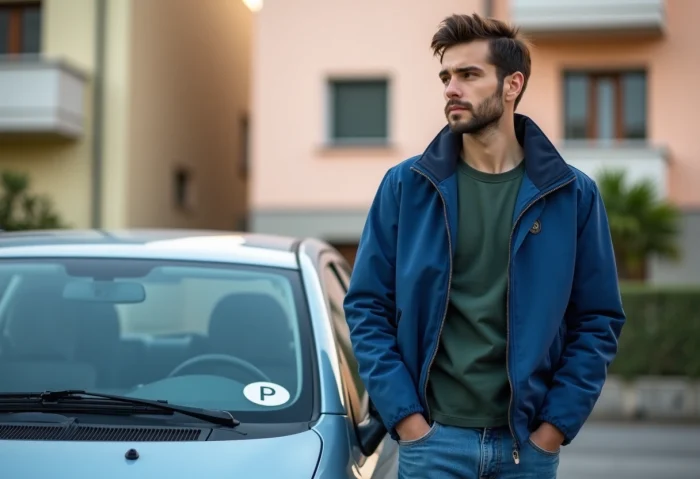
Claiming that the letter P on Italian cars hides a mysterious symbolism would be an exaggeration. However, many drivers wonder when they encounter this marking. In Italy, a vehicle displaying the letter P on its plate or windshield does not indicate a geographical origin or an administrative category. Unlike other European markings, this sign does not correspond to a standard registration or a specific permit issued to certain drivers.
This marking pertains to a temporary status, accompanied by specific rights and restrictions. Its use, governed by the Italian highway code, entails formal obligations for the vehicle owner. Ignoring the meaning of this symbol exposes one to penalties in case of a check.
What the letter P reveals about cars in Italy
The letter P appears on certain Italian cars and piques curiosity. This symbol, far from being a mere administrative mention, identifies a very specific case: it marks the presence of a learner driver behind the wheel of a driving school car. The mention “Principiante,” in Italian, is thus abbreviated, displayed on a blue plate at the front and back of the vehicle, as required by the highway code of the country. To ensure safety and clarity on public roads, the International Association of Driving Schools has standardized this system. The letter P has become established in Italy, but other European countries have made different choices:
- The letter L (for “learner” or “leerling”) is found elsewhere in Europe,
- Hungary has opted for T,
- and Israel uses a specific Hebrew alphabet.
This marking aims to alert other drivers: a learner is at the wheel, vigilance is essential. According to Italian legislation, failing to display or hiding this letter exposes one to fines. For those who want to delve deeper into the matter, the file “what does the P mean on cars in Italy” provides useful clarifications. The distinction from standard registration plates remains crucial, especially during frequent checks in major Italian cities.
Italian license plates: decoding the peculiarities and codes
Italian license plates are not just a series of numbers and letters. On a white background, between two blue bands, the country code “I” appears on the left, followed by a unique combination. This format has become widespread in the European Union, to facilitate travel, whether driving in Rome, Milan, or Turin. The time when one could identify the city of origin at first glance is over: today, the geographical mention has disappeared.
The letter P illustrates the diversity of markings used. But driving in Italy also means dealing with other specificities: here’s what every driver should keep in mind:
- Limited traffic zones (ZTL): access is restricted at certain times or to certain types of vehicles.
- Low emission zones (ZFE): these areas prohibit the circulation of excessively polluting vehicles or those without authorization.
Each zone is signposted. To enter the historic center of Milan, one needs an ecopass or the “Area C” authorization, to be affixed to the windshield. In Rome, Florence, or Turin, access to ZTL requires prior action: cameras continuously scan plates, ready to penalize any infraction. Even parking rules depend on colors:
- White lines: free parking,
- Blue lines: paid parking,
- Yellow lines: reserved or prohibited spaces.
To drive in Italy, the required documents vary depending on your origin:
- French or European driving license: sufficient for a temporary stay, no additional formalities.
- International license: necessary only for drivers outside the EU or EEA.
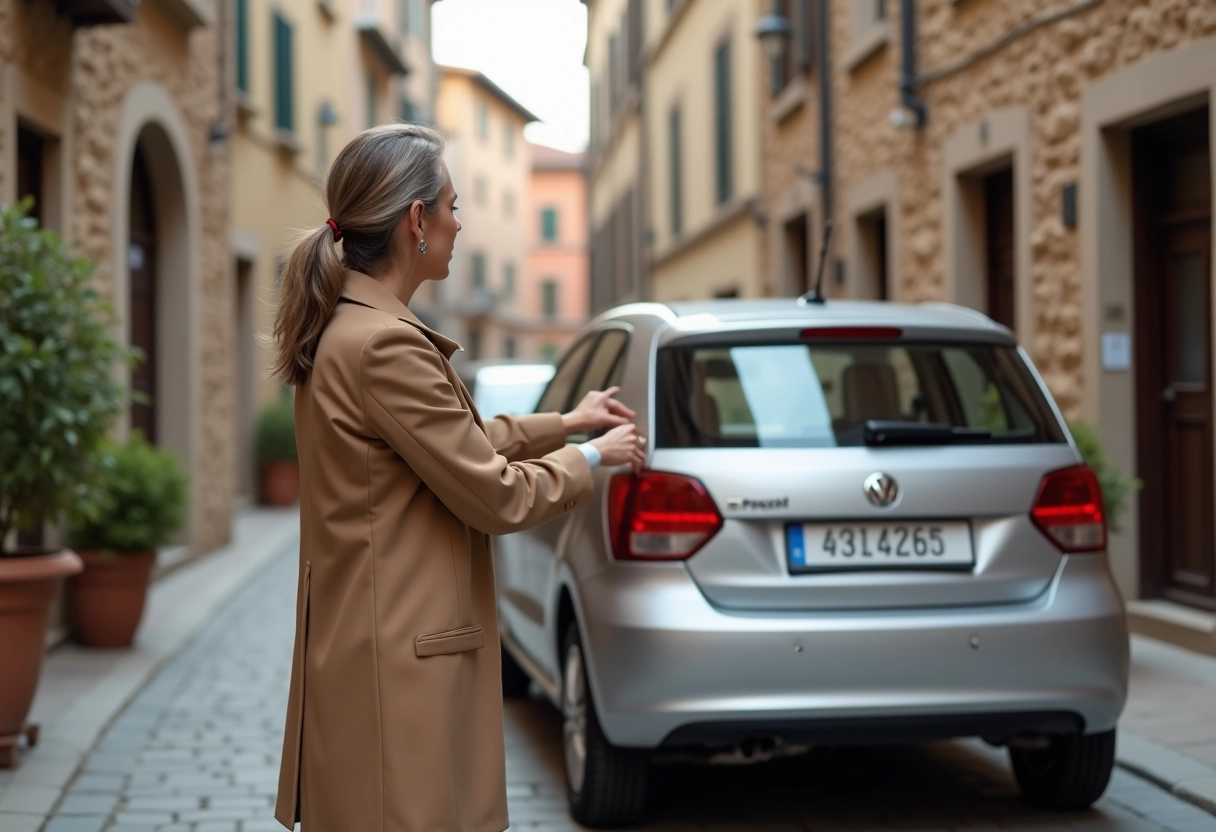
Driving safely in Italy: practical tips to respect local rules
Hitting the road in Italy means discovering sometimes surprising driving habits and rules to master. First vigilance: respect the speed limits! 50 km/h in urban areas, 90 to 110 km/h on fast roads, 130 km/h on highways. Outside cities, low beam headlights must remain on even during the day, a requirement closely monitored, especially on major routes.
The management of priorities also holds its share of subtleties. On recent roundabouts, priority goes to the vehicle already engaged; however, it all depends on the layout, so it’s best to closely observe the signage. Trams have priority, as do pedestrians at crosswalks. A small local specificity: during a left turn, both vehicles pass face to face, without going around from behind.
Before crossing the border, double-check your papers: French or European license, green insurance card, vehicle registration, ID. Don’t forget the reflective vest for each occupant and the warning triangle. Depending on the region and the season, chains or winter tires may be necessary. For blood alcohol content: the limit is set at 0.5 g/l, but it drops to zero for young drivers and professionals.
Some reflexes make driving easier:
- For parking, note the color of the lines: white for free, blue for paid, yellow for reserved or prohibited spaces.
- Beware of ZTL and ZFE: restricted access according to hours, omnipresent cameras, and automatic fines for violations.
Italian drivers are quick to honk and overtake vigorously, but they know to stop short in front of a pedestrian or tram. It’s up to everyone to adapt: on the Alpine roads, vigilance, flexibility, and respect for the rules remain the best allies to avoid unpleasant surprises and enjoy the journey.