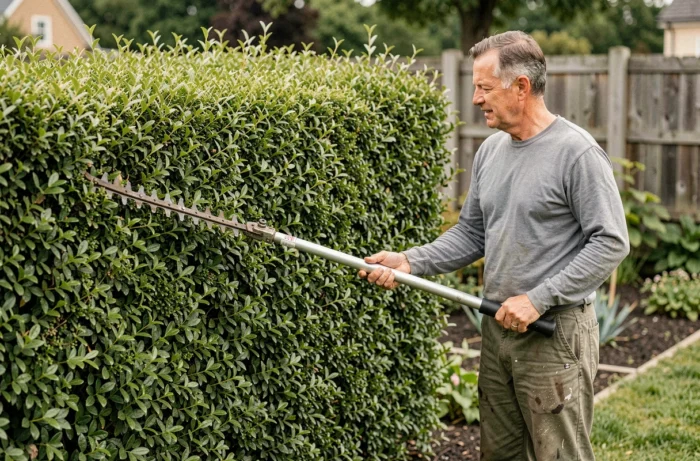
A two-metre-high, fifteen-metre-long thuja hedge means roughly 60 m² of vegetation to trim. With a blade that’s too short, you have to make more passes, your shoulders tire, and the result looks more like a hand-pruned job than a clean, even cut. Blade length directly affects how long the job takes, the quality of the cut and the physical effort required over a full session.
Weight, balance and fatigue with your arms raised: what blade length really changes
People often talk about blade length in centimetres, but rarely about what happens after ten minutes with your arms stretched above your head. A longer blade shifts the tool’s centre of gravity forwards. When you’re holding a hedge trimmer at chest height, the difference is barely noticeable. But as soon as you start trimming the top of a tall hedge, every extra centimetre of blade acts like a lever, pulling on your wrists and shoulders.
The effect is even more pronounced on a telescopic pole hedge trimmer. A long blade at the end of a pole increases the tipping force, making it much harder to maintain a straight cutting line. You compensate by gripping the tool more tightly, which quickly tires your forearms and makes it harder to cut accurately as the session goes on.
So the choice isn’t as simple as “longer blade = faster work”. A long blade on a lightweight battery-powered tool can still be manageable. The same blade on a heavier petrol model can turn trimming the top of a hedge into a workout. Before choosing the blade length for your hedge trimmer, consider the machine’s total weight and the height at which you’ll be working most often.
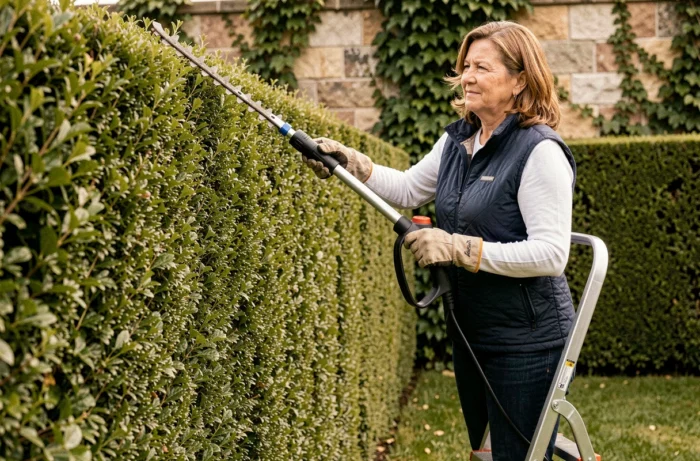
Blade length and hedge type: three practical examples
Rather than listing every available blade length, let’s focus on the three situations found in most gardens.
Low hedges and topiary: stay under 45 cm
A box ball, a lavender border or a small bed of ornamental shrubs calls for precision, not speed. A short blade gives you full control over the cutting angle and lets you follow rounded shapes without tearing branches.
With a 40 to 45 cm blade, the tool stays light and manoeuvrable enough to work around the shrub without effort. Any longer, and the tip of the blade may cut into an area you didn’t mean to touch, especially when shaping precise geometric forms.
Typical boundary hedges: the 50–60 cm range
This is the most common scenario: a thuja, laurel or cypress hedge between one and two metres tall, and five to twenty metres long. Here, you want a balance between working quickly and being able to trim both the sides and the top.
A 55 to 60 cm blade significantly reduces the number of passes compared with a shorter model, without making the tool unwieldy when working overhead. On a hedge around ten metres long, the time saved by using a 55 cm blade instead of a 40 cm one can add up to tens of minutes over a full trim (sides and top).
Large informal hedges: 60 cm and longer
For an informal hedge over two metres tall or a long stretch of hedge, a 60 to 75 cm blade makes good sense. Each pass covers a wider area, reducing the time needed to finish the job.
But there are real trade-offs: the tool weighs more, the balance changes, and fatigue sets in faster when working at height. For blades over 70 cm, a pole hedge trimmer is almost essential if you want to reach the top without a ladder, but manoeuvrability drops considerably. These lengths are best suited to informal hedges, where speed matters more than precision.
Blade, motor and cutting capacity: three factors to consider together
Choosing a long blade for an underpowered motor is a common mistake. The blade determines the diameter of branches that can fit between its teeth, while the motor provides the power to cut through them cleanly.
A corded electric or battery-powered model with a 60 cm blade will easily handle a few millimetres of soft growth. Faced with tougher branches, such as those on an unmaintained hornbeam or beech hedge, the motor struggles, the blades jam and you end up forcing the tool.
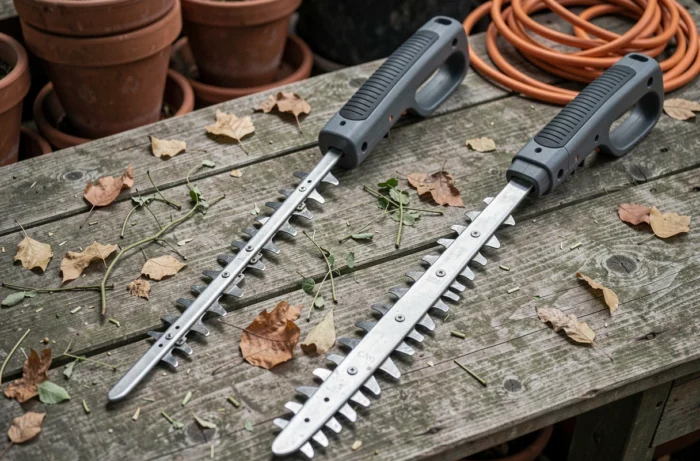
Cutting capacity (or tooth spacing) is related to blade length, but not proportionally. Two models with 55 cm blades can have different tooth spacing. Wider spacing accommodates thicker branches but gives a less even finish on fine shoots. For a regularly maintained hedge with young growth, closer-set teeth produce a cleaner finish.
- Regularly maintained hedge (2-3 trims a year): choose closely spaced teeth and a medium-length blade for a clean cut without straining the tool.
- Neglected hedge with woody branches: choose wider tooth spacing and make sure the motor can handle the job. If necessary, opt for a shorter blade to keep the weight manageable.
- Mixed use (low and tall hedges, borders and fences): a blade around 50-55 cm is the best all-round compromise.
Petrol, battery or corded: how the power source affects blade choice
The power source directly affects the tool’s weight, and therefore the blade length you can use comfortably. A petrol hedge trimmer is generally heavier than a battery-powered model with the same blade length. With a 70 cm blade, a petrol model can easily become too heavy for prolonged overhead work.
Lithium-ion battery models have narrowed the power gap with petrol models when it comes to short and medium-length blades. For home use with standard-sized hedges, a battery-powered hedge trimmer with a 50 to 60 cm blade will meet most needs without the hassle of a cord or the weight of a petrol engine.
Corded models are still a good choice for small gardens where cable length isn’t an issue. Their advantage is lower weight for the same blade length, since they don’t have a fuel tank or battery. This means you can choose a longer blade without adding too much to the overall weight.
- Petrol: best for long stretches of hedge and tough branches; expect a heavier tool and choose a shorter blade if you’ll be working overhead a lot.
- Battery: versatile and suitable for 45 to 60 cm blades; keep an eye on battery life when trimming large hedges.
- Corded: ideal for long blades in small areas, as long as you can manage the cable.
Blade length shouldn’t be chosen from a comparison chart alone. Consider your hedge’s height and type, how much weight you’re comfortable holding overhead for half an hour, and the tool’s power source. A blade that’s too long causes fatigue and compromises the cut; one that’s too short makes the job take longer. The right length is the one that lets you finish trimming without sore shoulders the next day.