
A graphic design training program is not just a list of software to master. The modules taught, their relative weight in the curriculum, and the skills they mobilize outline the professional daily life that awaits future graduates. Analyzing this educational content allows us to distinguish the programs that prepare students for the reality of the job from those that skim the surface.
Typography, colorimetry, composition: the technical fundamentals of graphic design
Before any visual creation, a graphic designer works with three pillars: typographic choice, color management, and layout. These three disciplines occupy a central place in the initial months of training, and for good reason.
Typography determines the readability and tone of a medium. Knowing how to pair a serif font with a sans-serif, adjust letter spacing, or adapt body text for a mobile screen involves precise technical knowledge. Programs that dedicate several weeks to this indicate a curriculum focused on design rigor.
Colorimetry distinguishes amateur work from professional work. Understanding the difference between an RGB profile intended for the web and a CMYK profile for print, calibrating a screen, anticipating the output on coated or offset paper: these technical skills determine the final quality of a deliverable. When you spot these modules in a program, expect a job where precision matters as much as creativity.
Analyzing the content of a graphic design training program from this perspective allows you to assess whether the curriculum allocates enough space to these fundamentals or if it skims over them in favor of more spectacular but less structuring workshops.
Visual communication and strategy: what software alone does not cover
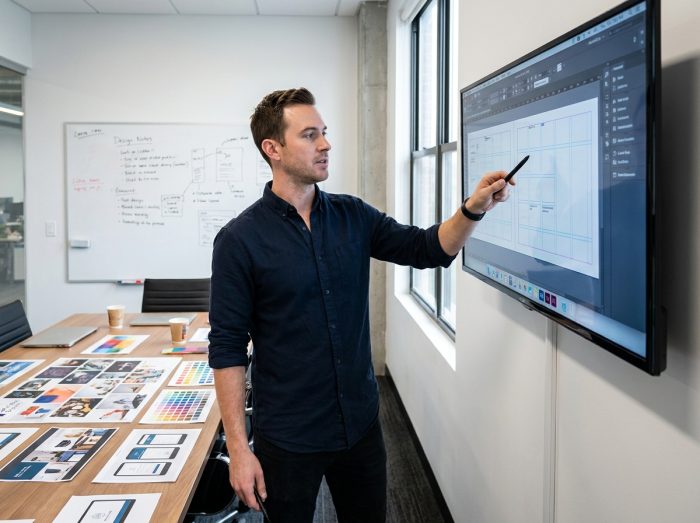
A program that limits itself to teaching Photoshop, Illustrator, and InDesign prepares executors, not designers capable of driving a project. Visual communication involves understanding why a visual works, not just how to produce it.
Modules on art direction, image semiotics, or visual marketing reveal a training oriented towards creative strategy. The graphic designer in position, whether in an agency or freelance, spends a significant part of their time on:
- Translating a client brief into argued graphic proposals, justifying each choice of color, layout, or typography in relation to the target audience
- Adapting a visual identity across multiple media (web, print, video, social media) while maintaining brand consistency
- Presenting and defending their proposals to non-designer stakeholders, which requires skills in argumentation and simplification
Programs that integrate real-world projects, with an external client and time constraints, better prepare students for this strategic aspect than those that focus solely on isolated technical exercises.
AI automation and graphic design training: the gap to watch
The arrival of artificial intelligence tools in graphic creation profoundly changes the distribution of work time. Repetitive production tasks (clipping, generating variations, resizing visuals for different formats) are now considerably accelerated by these tools.
For studios and freelance designers, AI drastically reduces the time spent on basic tasks in favor of strategic thinking, art direction, and client relations. The profession is shifting up the value chain.
A training program that dedicates the majority of its hours to the technical learning of software without addressing this transformation risks creating a gap. Graduates enter the market with execution skills that automation makes less differentiating, while employers and clients seek profiles capable of leading the creative strategy.
Positive signals in a program: modules dedicated to the reasoned use of generative AI, workshops on prompt design applied to graphic design, and especially a reflection on the designer’s positioning in relation to these tools. Warning signals: a program identical to that offered five years ago, without mention of these developments.
Multidisciplinarity in curricula: web, video, and motion design
The boundaries between graphic design, web creation, and audiovisual production have blurred. A designer today regularly engages with short video for social media, motion design for animated presentations, and the design of web interfaces or applications.
A training program that strictly separates print graphic design from digital design no longer reflects the reality of the job. The most relevant programs integrate these areas:
- Introduction to motion design and animation with tools like After Effects, to meet the growing demand for animated content
- Basics of UX/UI design to understand the ergonomic and accessibility constraints of digital interfaces
- Light video production, from shooting to editing, for short formats intended for digital marketing
This multidisciplinarity does not mean that every student will become a specialist in everything. It ensures a comprehensive understanding of the visual production chain, which then allows for informed specialization.

Reading a graphic design training program like a job description
The hourly volume allocated to each module serves as an indicator of the skills valued upon graduation. A program that reserves half of its hours for software and a quarter for design theory prepares a profile of a graphic operator. One that balances technique, strategy, and real-world projects trains designers capable of managing a visual communication project from start to finish.
The presence of long internships or client projects in the curriculum remains the best indicator of a training program connected to the market. Field feedback, corrections by active professionals, and exposure to real briefs compensate for what no lecture can convey: the ability to make decisions under pressure.
The graphic designer profession is evolving rapidly. A relevant training program in 2025 will have little in common with that of ten years ago, and students who take the time to examine the details of the modules before enrolling gain valuable time in their professional orientation.