The color of a liner is not chosen from a color chart placed on a living room table. The final result depends on the depth of the pool, solar orientation, the chemical treatment of the water, and how the PVC ages under UV stress. Here we discuss the technical parameters that truly determine the perceived hue of the water, far beyond mere decorative effect.
Aging of the liner and discoloration: what alters the color over time
A liner does not retain its original hue indefinitely. Areas exposed to sunlight and the waterline fade first, because UV rays degrade the plasticizers and pigments in the PVC in a localized manner. Heat accelerates this process, meaning that a pool facing directly south in the South of France will experience faster chromatic aging than a semi-shaded pool in Brittany.
Chemical dosing errors exacerbate the phenomenon. An excess of chlorine, a highly fluctuating pH, or concentrated products poured directly to the bottom of the pool attack the membrane and cause localized marks that are impossible to erase. Established discoloration is generally not reversible: no maintenance product can restore lost pigments.
This point has a direct consequence on the choice of color. A dark liner (anthracite gray, dark green, black) hides the first signs of aging longer than a light blue or white liner, where even the slightest color variation is glaringly obvious. However, a dark liner that whitens at the end of its life displays a stark contrast between protected areas and degraded areas.
We recommend anticipating this trajectory from the moment of purchase: a pool liner color simulator on Idees-maison.com allows you to visualize the result before committing to a hue.
Interaction between water treatment and liner color
The disinfection method influences the durability of the pigments in the coating. Salt electrolysis, for example, is not automatically incompatible with a PVC liner, but the membrane, sealing components, and treatment system must be sized to work together. A standard liner installed in a pool equipped with a poorly adjusted electrolyzer may see its hue shift prematurely.
The colored stains that sometimes appear on the coating provide information about their chemical origin. Blue-green or turquoise marks often indicate a copper deposit related to a too-low pH or corroded pipes. Brown or rust marks point to a concentration of iron or manganese in the fill water.
- A light liner (white, sand, pale blue) makes stains more visible but facilitates their early diagnosis.
- A dark liner (gray, black, dark green) conceals surface deposits but delays the detection of a chemical imbalance.
- A patterned liner (stone effect, frieze, tiling) camouflages localized imperfections while adding a decorative dimension to the pool.
The choice of color should therefore integrate the planned treatment protocol. A diligent owner regarding chemical balance can afford a white liner without fear. A pool fed by a well rich in metals would benefit from avoiding very light shades.
Pool depth and perception of water hue
The perceived color of the water does not depend solely on the liner. The depth of the pool amplifies or attenuates the saturation of the hue. A light gray liner in a shallow flat-bottom pool gives translucent, almost silver water. The same liner in a diving pit produces a deep blue-gray, sometimes dark.
This phenomenon is explained by the selective absorption of light by water. The higher the column of water, the more red and yellow wavelengths are absorbed, which enhances blue and green tones. A sand liner in a deep pool will not yield the expected turquoise water, but rather an emerald green.
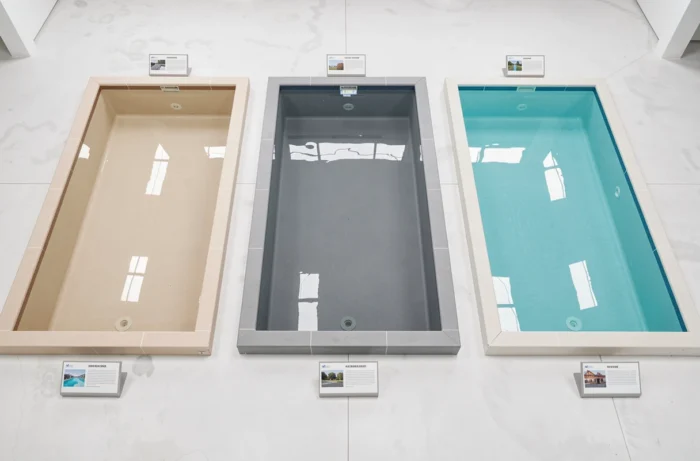
We regularly observe disappointments among clients who chose their liner based on a dry sample, without considering the geometry of their pool. A sample submerged in a bucket does not reproduce the actual rendering either, as the water height remains insufficient. The only reliable method is to consult photos of realizations with the same liner reference in pools of comparable dimensions.
Sand, gray, or blue liner: deciding based on the external environment
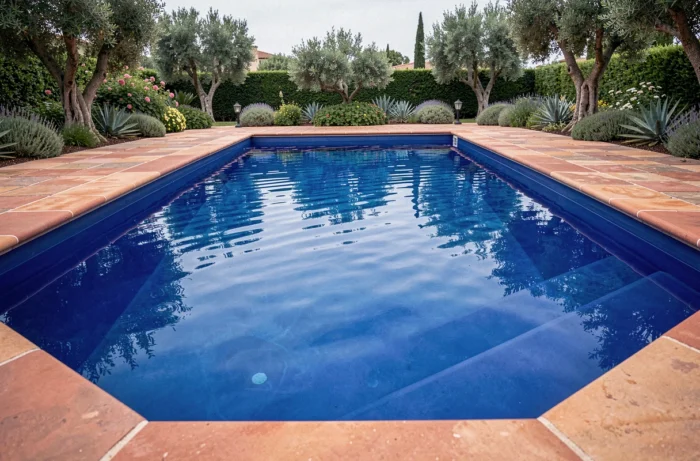
The pool does not float in a void. The color of the liner must interact with the coping, the terrace, the vegetation, and the facade of the house. A bright blue liner in a Mediterranean garden surrounded by limestone and olive trees creates a visual break. An anthracite gray liner with dark exotic wood coping produces a coherent contemporary ambiance.
- Sand or beige liner: natural rendering, turquoise-green water, integrates well into stone or light wood environments.
- Gray liner (light to slate): mirror effect, blue-gray water, suitable for modern architectures and composite terraces.
- Blue liner (light or dark): classic pool effect, bright blue water, versatile but less distinctive.
- Black liner: natural pool or water mirror effect, faster temperature rise, but accentuates the visibility of limestone deposits.
Black deserves special attention. It heats the water more through solar absorption, which can be an advantage in cooler regions. Conversely, white calcium deposits are immediately visible on a black liner, necessitating more frequent maintenance of the waterline.
Finish and texture of the liner: the effect on color rendering
The same color of PVC does not produce the same visual effect depending on whether it is smooth, textured, or embossed. Stone or mosaic effect liners break the reflective surface and disperse light, which reduces color saturation. A smooth liner, on the other hand, amplifies the mirror effect and intensifies the perceived hue.
Liners with hanging (hung or overlap) also exhibit differences in tension on the walls, which alters how light strikes the coating, especially at the stairs and corners. A poorly tensioned liner creates micro-pleats that trap dirt and locally alter the hue.
The color of the liner is as much a technical choice as an aesthetic one. Differential aging, water treatment, depth, and PVC finish each weigh on the final rendering. Choosing a hue without integrating these parameters is akin to deciding on the paint for a facade without knowing the orientation of the wall.