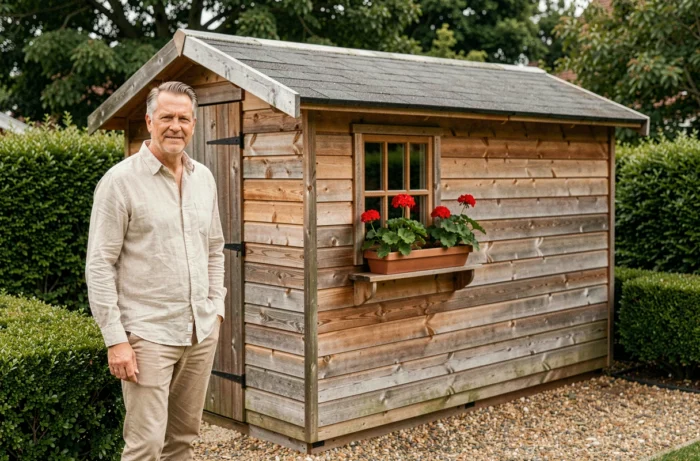
A garden shed can trigger up to three distinct administrative procedures, at different times and with separate contacts. Confusing these obligations risks either a tax reassessment, a violation of the urban planning code, or both simultaneously. Here we detail what each procedure concretely entails and how they are interconnected.
Three distinct procedures for the same garden shed
The most common confusion is to believe that a single formality covers all obligations. In practice, urban planning, property taxation, and development tax fall under separate processes. Submitting a prior declaration to the town hall does not count as a tax declaration to the tax authorities, and paying the development tax does not exempt one from reporting the construction in the property occupancy declaration.
The typical timeline breaks down as follows:
- Before construction: submission of a prior declaration of works or a building permit at the town hall, depending on the floor area and footprint of the shed.
- Within 90 days following completion: submission of the declaration form to the property tax center for updating the cadastral rental value of the property.
- After processing the urban planning file: possible issuance of the development tax by the departmental directorate of territories, with one or two payment notices depending on the amount.
Each step generates its own consequences in case of omission. An owner who has correctly obtained their urban planning authorization but forgot the tax declaration will find their shed absent from the calculation of property tax, which constitutes an exploitable irregularity during an inspection.
To delve deeper into the interactions between these obligations, the page dedicated to the garden shed tax declaration details the cases where one of these procedures automatically triggers the other.
Urban planning declaration at the town hall: thresholds and common pitfalls
The urban planning code sets surface thresholds that determine the type of authorization required. Below a certain footprint and floor area, no urban planning formality is required. Beyond that, a prior declaration of works is sufficient in most cases. A building permit is only required for the largest sheds.
The most common pitfall concerns sheds attached to the house. When the shed is adjacent to the main building, it is legally treated as an extension. In municipalities with a local urban plan (PLU), the threshold triggering the building permit may be raised compared to a standalone construction.
Protected areas and local rules
In protected sectors, historic monument perimeters, or classified sites, the exemption thresholds are lowered. A shed that would require no formality in an ordinary area may require a prior declaration in a protected area. We recommend systematically consulting the PLU or the municipal map before any purchase, including for a small shed.
Failure to comply with these rules exposes one to an infraction report issued by the municipality, regardless of any tax issues. The penal fine for construction without authorization can be significant, and the town hall may require compliance or demolition.
Development tax: calculation and possible exemptions
The development tax is due for any construction creating enclosed and covered floor area beyond the minimum surface threshold. It is calculated based on a fixed value per square meter, revised annually, to which the rates voted by the municipality and the department apply.
Several situations allow for legal exemption:
- The shed remains below the minimum surface threshold triggering the tax.
- The ceiling height is insufficient for the area to be considered enclosed and covered in a fiscal sense.
- The municipality has deliberated to exempt ancillary constructions up to a certain surface threshold.
- The shed replaces a construction destroyed by disaster within a regulatory timeframe.
The point of caution concerns removable structures. A shed without a foundation, installed for less than three months a year, is generally exempt from the development tax and urban planning authorization. This timeframe drops to 15 days in protected areas. Beyond that, the structure is classified as a permanent construction.
Development tax and property tax: two different logics
The development tax is a one-time (or split into two payments) levy collected at the time of construction. The property tax, on the other hand, is annual and depends on the cadastral rental value of the property. A garden shed that increases this rental value can raise the property tax each year, even if the development tax has already been paid.
We observe that this distinction escapes many property owners. Paying the development tax does not close the tax aspect: it remains to verify that the property declaration has indeed been made to avoid later catch-up by the administration.
Tax control and regularization of an undeclared shed
The tax authorities now have aerial imaging detection tools, combined with analysis algorithms. The cross-referencing of cadastral data and satellite views allows for the identification of undeclared constructions, including modest-sized sheds.
If your shed already exists without having undergone the required formalities, regularization involves the retroactive submission of the urban planning file at the town hall and the property declaration to the tax office. The town hall examines compliance with the current PLU at the time of the request, not at the time of construction. A shed that was once compliant may therefore be found in violation if local rules have changed.
On the tax side, the administration may claim missing property taxes for several years back. The development tax, on the other hand, is prescribed after a few years if it has never been issued, but this prescription does not cover the urban planning violation, which follows a distinct regime.
The key point to remember: spontaneous regularization is less costly than waiting for a control. The town hall has urban planning police powers independent of the tax authorities, and both administrations can act in parallel without coordinating.