A property listed as “residential use premises” in a real estate advertisement does not necessarily refer to a classic apartment. Behind this wording lies a legal qualification that affects the price, the authorized works, and even the possibility of living there legally. Before signing a preliminary agreement, understanding this distinction helps avoid extra costs and administrative blockages that many buyers discover too late.
Change of use of a premises: what the Urban Planning Code really requires
We regularly come across former shops, offices, or studios sold at attractive prices compared to the residential market in the same neighborhood. The reflex is to envision: knock down a wall, install a kitchen, and it’s done. In practice, transforming a premises into housing constitutes a change of use under the Urban Planning Code.
This change of use requires at least a prior declaration at the town hall. If the works affect the façade or the load-bearing structure of the building, a building permit must be submitted. The file then goes through the appropriate Cerfa form, and the municipality checks compliance with the local urban planning plan (PLU).
Even before submitting a file, two documents must be checked: the PLU of the municipality (which may prohibit housing in certain areas) and the co-ownership regulations if it is a unit in a building. Restrictive co-ownership regulations can block the project even if the town hall gives its approval. To better understand the differences between residential premises and apartments, one must start from this double legal and urban verification.
Development tax and fiscal cost of converting to housing
A commercial premises sold for less than an equivalent apartment in size may seem like a good deal. The calculation changes when we factor in the taxation related to the transformation.
For authorizations issued from February 15, 2025, the development tax may apply even when the transformation does not create any additional surface area. Before this date, only the creation of new surface area triggered this tax. This change profoundly alters the financial equation of a conversion project.
In practical terms, a former 60 m² office converted into a studio could previously escape this tax. This is no longer guaranteed. The amount depends on the municipality and the rate voted by the local authority, but the budget surprise can represent several thousand euros that the buyer had not anticipated.
Law of June 16, 2025, and reversible permit
The law of June 16, 2025, introduced exemptions to the destination rules of the PLU to facilitate the conversion of offices or shops into housing. It also created a mechanism for a reversible permit valid for twenty years, which allows certain subsequent changes of use without restarting the procedure from scratch.
This system does not guarantee the feasibility of every project: the authorization remains subject to the decision of the competent authority. Therefore, one cannot purchase a premises blindly counting on this exemption.
Energy performance: DPE and rental restrictions for an apartment
When buying an apartment already designated for housing, the question of change of use does not arise. However, energy performance now directly affects the property’s value and its ability to be rented.
Since January 1, 2025, properties rated G in the DPE are prohibited from being rented. For a buyer considering a rental investment, acquiring an apartment rated F or G without a budget for energy renovation works amounts to buying an unusable property in the short term.
- Check the DPE class before any purchase offer, by requesting the complete diagnosis and not just the label displayed in the advertisement.
- Estimate the cost of energy renovation if the property is rated E, F, or G, as the rental prohibition thresholds will tighten in the coming years.
- Distinguish between a DPE carried out before or after the reform of the calculation method, as older diagnostics may underestimate actual consumption.
For a premises converted into housing, the DPE must be carried out after the works. This means that the insulation and heating system installed during the conversion directly determine the energy class obtained, and thus the possibility of renting the property.
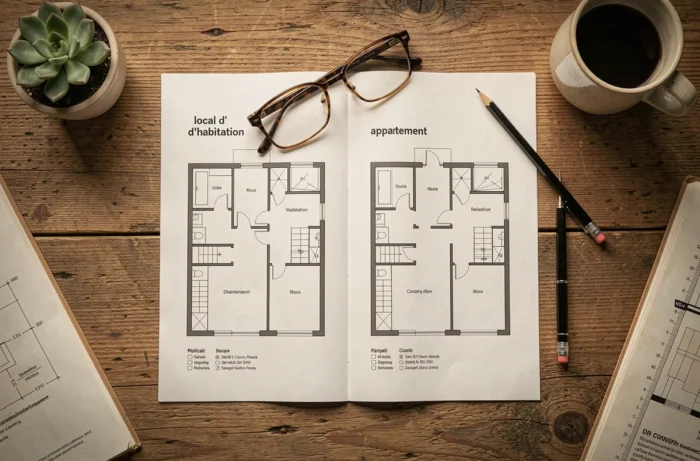
Concrete checks before signing: premises or apartment
Whether buying a classic apartment or a premises to convert, certain control points overlap. Others are specific to the type of property.
For a premises to convert
- Consult the PLU at the town hall to confirm that the area allows for housing, and request an operational urban planning certificate that commits the municipality to feasibility.
- Read the co-ownership regulations in full, looking for the destination clauses of the lots. A “all businesses” clause does not automatically authorize housing.
- Estimate the potential development tax with the urban planning department before finalizing the purchase offer.
- Check the compliance of networks (wastewater drainage, electrical supply) with habitability standards, as a commercial premises does not have the same technical standards as a housing unit.
For an existing apartment
Focus on the title of ownership, the absence of mortgages or easements, and the compliance of the DPE. The co-ownership charges also deserve careful examination: calls for funds for works voted but not yet carried out sometimes remain the responsibility of the buyer if the preliminary agreement does not provide for their distribution.
The choice between a premises to convert and an apartment ready to live in depends on the overall budget, not just the displayed purchase price. A cheaper premises per square meter may end up costing more once the works, development tax, and compliance costs are added. Putting these calculations on paper before making an offer remains the most reliable way to avoid an unpleasant surprise at the notary’s office.