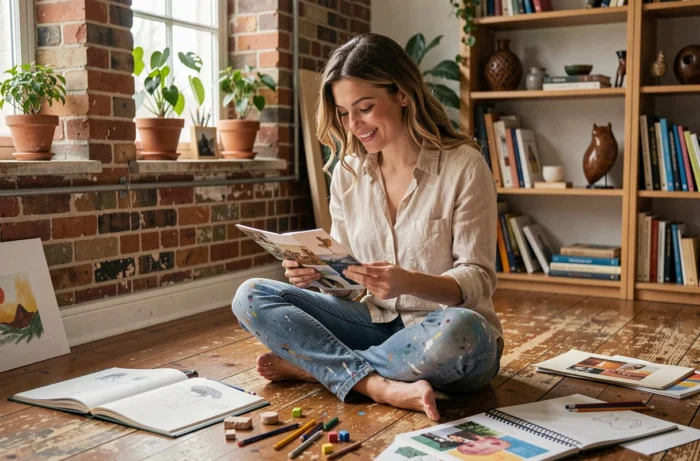
Everyday entertainment is about more than just consuming content. Finding original ways to have fun means understanding what creates genuine engagement: an activity that captures your attention without becoming an obligation. Most lists of activities miss the mark here: they suggest formats without examining what makes a pastime sustainable.
Brief moments of focused attention: enjoy yourself without making anything
A pilot study published in 2024 evaluated a guided art-viewing session in a gallery. The results showed a decrease in perceived stress and improvements in measures of mindfulness. Slowly observing a work of art, with no goal of producing anything, is an underused way to have fun.
This kind of brief, focused attention works outside museums, too. Notice an architectural detail on your street, study the composition of a poster, or watch an insect move for five minutes: the process involves shifting from automatic perception to deliberate attention.
The data cited come from a one-off intervention, not evidence of lasting effects. What matters most is the principle: looking closely can replace a productive activity for anyone seeking to have fun without the pressure to achieve an outcome. Idea directories such as sedivertir.eu feature these kinds of suggestions alongside more traditional options, making it easier to try different types of activities.
Time constraints and local access: the real test for leisure ideas
A review by the Ministry of Culture notes that cultural and leisure activities vary considerably depending on what facilities are available nearby. Even the most original idea in the world is useless if it requires an hour’s travel or expensive equipment.
Local accessibility matters more than theoretical originality. Before deciding what to do, map out what’s available within a fifteen-minute walk or bike ride: a library, park, community center, market, or public sports facility. Sustainable everyday entertainment starts close to home.
Three practical filters can help you assess a leisure activity before committing to it:
- Getting started should take less time than doing the activity. If setting up takes longer than the activity itself, you’ll be less likely to keep it up.
- You should be able to do it alone or with family without rearranging your schedule. Thirty minutes is enough for reading, drawing, a quick board game, or a music session.
- Ongoing costs should be close to zero. Free activities (walking, writing, video games you already own, cooking with what you have) are the ones that last beyond the first week.
Everyday creative activities: what the data really shows
Creative hobbies are often presented as a remedy for stress. Observational research cited by Keyes et al. (2024) shows an association between arts and crafts activities and greater subjective well-being. The link is statistical, not causal: taking up a creative hobby doesn’t guarantee a measurable reduction in stress.
This distinction changes how you choose an activity. It’s better to pick a creative hobby out of curiosity or enjoyment than in the hope of therapeutic benefits. Intrinsic enjoyment is the best predictor of consistency, not the promise of well-being.
Creative activities that fit into everyday life and require no specialized equipment include:
- Freewriting (ten minutes, without rereading, on a topic suggested by a random prompt generator or a word picked at random from a book).
- A quick sketch of an everyday object in pen, without an eraser. The constraint of a permanent line encourages close observation and takes the pressure off making it look good.
- Improvising on an instrument you already have at home, even if you’re not very good at it. The goal is not to perform but to explore sounds.
- Experimental cooking: choose an unusual ingredient and add it to a familiar dish. Putting a new spin on a familiar recipe sparks more curiosity than following a complicated recipe to the letter.

Games and digital entertainment: break out of passive habits
Opening a streaming platform is an easy way to relieve boredom in the moment, but it rarely leaves you feeling satisfied. The difference comes down to cognitive engagement. A puzzle or strategy video game engages you more than passive viewing.
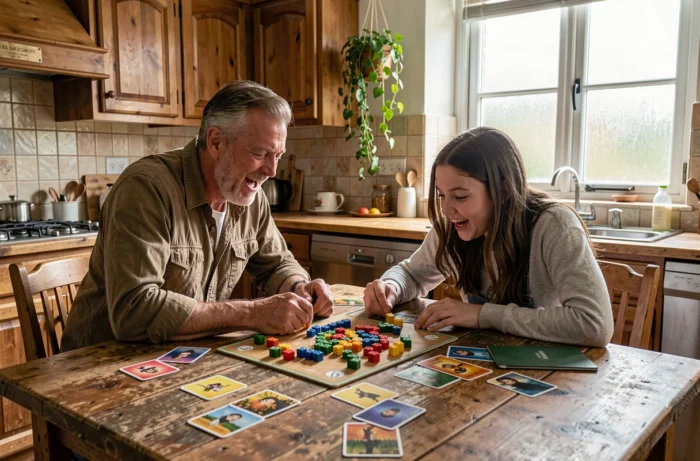
For families with children, cooperative games—whether board games or video games—create a different dynamic from competitive ones. Cooperation calls for communication, negotiation, and a shared goal: three ingredients that turn entertainment into quality time together.
Digital media also offers hybrid formats that are often overlooked: learn the basics of video-editing software to document everyday life, code a small interactive program using free online tools, or take part in creative challenges on specialist forums. These activities combine learning and fun, sustaining interest beyond the initial novelty.
Build a rotation of activities instead of a list
Most articles offer lists. The problem with a list is that you browse it once and then forget about it. A more effective approach is to create a weekly rotation of three or four activities that alternate between different types: something physical (walking, sports, dancing), something that calls for focused attention (observing, reading), something creative (writing, drawing, music), and something social (a family game, calling someone close to you, or going to a community event).
This rotation doesn’t require rigid planning. Simply assign a type of activity to each day and choose what to do at the last minute, depending on your energy level. Varying the types of activities prevents boredom better than adding more ideas within the same category.
Lasting everyday entertainment rests on three pillars: proximity, no cost, and variety. Everything else is just a catalog. A good catalog helps you get started, but a rotating structure is what keeps you engaged over time.