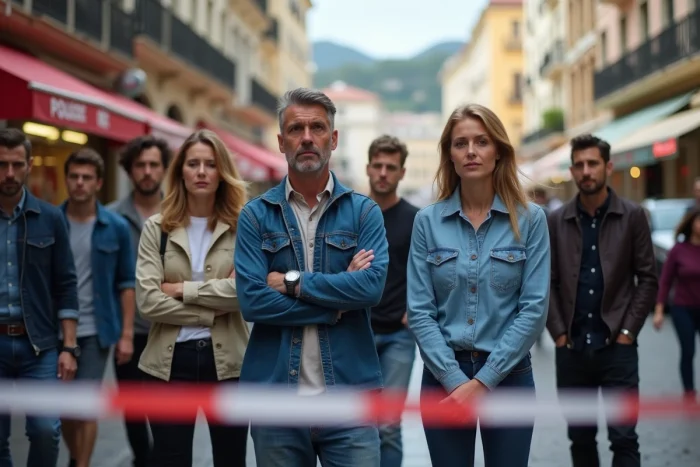
The news broke without warning, cutting through an ordinary morning in Cannes: restricted access, law enforcement deployed, downtown under tension. The threat, announced bluntly by the authorities, imposed a crisis discipline from dawn. Within minutes, national and municipal police gathered around the affected establishments, locking down the city’s strategic points.
Since midday, social media has been buzzing with videos and testimonies captured on-site. The footage, taken from surveillance cameras and shared by witnesses, offers a raw glimpse of the initial chaos. The authorities, far from downplaying the event, have validated the origin of these images, reminding that every detail matters to establish the exact timeline. The investigation is progressing meticulously: it is now about understanding not only the day’s scenario but also the profile of the suspected alert’s author.
What we know at this stage about the attack in Cannes
This morning, the heart of Cannes was shaken by an unprecedented frenzy. From the first signals, national and municipal police converged on the Palais des Festivals. According to the Alpes-Maritimes prefecture, the Croisette fell into confusion following the spread of rumors on social media. In a matter of moments, festival-goers, film professionals, and onlookers evaporated, some caught in a whirlwind of panic around the Festival.
Mayor David Lisnard quickly spoke out to cut short the speculation: no attack occurred. The information provided by the departmental security confirms this: no shooting, no victims, no injuries. The Paris anti-terrorist prosecutor’s office has nonetheless opened an investigation to trace the source of the alert and dissect the mechanics of false information. Thanks to a coordinated response, the consequences were contained. Only the Semaine de la Critique and the Quinzaine des Réalisateurs experienced a forced pause while the situation was clarified.
The collected images, whether from the city’s cameras or via festival-goers’ phones, reveal a crowd movement, but nothing resembling an armed attack. Cooperation between security services and the judiciary remains at the center of the operation, with the memory of the Nice attack in 2016 still fresh in the region. Cannes must now deal with this diffuse tension, balancing the wait for reliable information and the need to maintain vigilance.
For complete and updated coverage, the latest news on the Cannes attack is available and updated throughout the hours, relaying the work of the authorities and teams on-site.
First images: what key elements about the incident’s unfolding?
The recordings captured on the Croisette and around the Palais des Festivals reveal a rapid sequence of hurried movements. Thanks to surveillance cameras and festival-goers’ smartphones, we see how quickly a rumor transforms into collective movement.
Here’s what these first images show:
- groups dispersing at high speed,
- closed faces, sometimes struck by astonishment,
- some screams piercing the noise,
- but no signs of an armed attack or physically harmed individuals.
What measures are in place?
Several security measures had been anticipated to oversee the festival and its surroundings. Among them:
- Smart cameras, already tested in anticipation of the Paris 2024 Olympic Games, allowed for a quick sweep of the area and the detection of suspicious behaviors.
- The law enforcement agencies, both national and municipal, conducted the evacuation, preventing the panic from spreading further.
Journalists dispatched to the scene reported the extreme speed of the rumor’s spread. While reality struggled to assert itself, film professionals present for the Festival found themselves confined in secure spaces, waiting to dispel doubts. The emergence of amateur videos, accessible instantly, heightened the confusion. In response, the Cannes departmental security spoke out to restore the timeline. The cross-referencing between smart cameras and testimonies demonstrates that the day’s panic was fueled by a false alert, not a violent act.
School security put to the test: what questions do these events raise for the community?
The disturbances this morning, exacerbated by the viral circulation of false information, test the ability of educational institutions to react under pressure. The proximity of schools to the critical points in downtown, especially during the Cannes Festival, increases the tension felt by the educational community. In the face of these challenges, the Alpes-Maritimes prefecture, in conjunction with the national police and the Vigipirate plan, is re-evaluating its alert and evacuation procedures.
Several areas for improvement emerge:
- Making communication between school leaders, teachers, parents, and security services smoother to stem the spread of rumors.
- Adapting lockdown and evacuation drills, already practiced in French schools, in preparation for the Paris 2024 Olympic Games.
The example of Nice, struck in 2016, continues to weigh on tactical choices: managing collective emotion and the memory of attacks shapes strategies. The smart cameras, whose use is expanding in Cannes and will soon be generalized for the Olympic event, offer faster detection of suspicious behaviors but also raise questions about privacy protection. The atmosphere is one of vigilance: between Operation Sentinel and the reorganization of institutions, managing student departures and arrivals must now integrate the emotional dimension.
Interior Minister Gérald Darmanin recently emphasized: the adaptation of measures must be constant in the face of a shifting threat, particularly that posed by the Islamic State in Khorasan, the main concern for the DGSI. In this climate, the educational community is seeking how to combine security, pedagogy, and trust, without succumbing to fatigue. In Cannes as elsewhere, vigilance is now the norm, well beyond the festival’s spotlight.