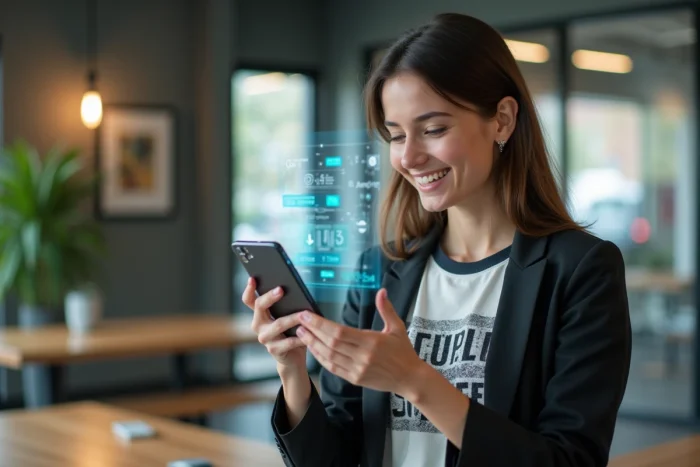
The bold promises of yesterday sometimes become footnotes today, while more discreet advancements impose themselves in everyday life without fanfare. Innovation offers no respite, shaking the certainties of analysts and reshuffling the cards each season.
The major tech events of recent months have not only revealed new objects or services. They have primarily highlighted unexpected uses, as well as unprecedented collaborations between industry giants and startups. The landscape is constantly evolving, blurring the boundaries between mere gadgets and high-impact solutions.
Overview of the major high-tech trends shaping the year
The high tech sector is undergoing a profound transition, driven by a continuous wave of technological innovations. At the forefront, generative artificial intelligence is taking center stage, showcasing its applications in content creation, task automation, and business process optimization. No one can ignore the debate on algorithm governance and responsible data management: the topic of ethical artificial intelligence is now on the agenda of leaders.
In France, public laboratories and startups are multiplying initiatives, with a strong focus on energy efficiency and cybersecurity. Large companies are accelerating their transition to the cloud to gain agility and resilience. This dynamic stimulates innovation in data protection and encourages the rise of open standards.
Digital health and mixed reality are at the center of expectations. The number of immersive devices and collaborative platforms developed in recent months is countless, as are the intuitive interfaces transforming training, medicine, or industry. Virtual reality, once a mere pastime, is becoming a structuring tool for many sectors.
Tech news on Buzz du moment reflects this movement: cross-analyses, selection of disruptive solutions, daily monitoring of innovation. Professionals closely follow the rise of artificial intelligence as well as the profound transformation of uses at work and in everyday life. Digital is reinventing itself, driven by a demand for trust, transparency, and concrete utility.
What notable innovations were unveiled at tech shows?
The high-tech calendar has been marked by the Consumer Electronics Show in Las Vegas, an event that remains the preferred stage for major announcements. This year, the revelations were plentiful: augmented reality glasses made a significant impact, featuring an expanded field of view and increasingly seamless integration into our digital environment. Several French companies were praised for their ability to combine mixed reality and efficiency in the professional world.
Entertainment has undergone a rejuvenation thanks to flexible screens integrated into astonishing prototypes. Robotics, meanwhile, confirms its progress: companion robots that learn, interact, and assist daily, a plethora of solutions dedicated to health, training, or gaming. Startups from around the world are competing in inventiveness, whether it’s miniaturized medical sensors or breathtaking immersive devices.
Here are some concrete examples of this technological abundance:
- Samsung Galaxy: a new generation of smartphones designed to integrate augmented reality into the user experience.
- Programmable domestic robots, designed to assist the elderly or make life easier for families.
- Modular microLED screens, capable of displaying images with unprecedented sharpness and brightness.
The CES Vegas also highlighted digital health, with remote diagnostic solutions, personalized monitoring, and artificial intelligence applied to prevention. The boundaries are fading: technology is entering all aspects of daily life, creating new connections between our needs and the emerging digital responses.
Technologies that are already transforming our daily lives: what concrete impacts for users?
High tech is no longer just about announcements. It is gradually becoming part of everyday life. At home, the Withings connected mirror becomes a health tracking tool: it analyzes posture, detects physiological variations, and displays an immediate report. No need to schedule a doctor’s appointment to get initial indicators: everything happens in front of the mirror, in just a few minutes.
The evolution of digital health goes even further. Sensors worn on the wrist or integrated into clothing continuously collect data on heart rate, sleep, or breathing. Connected to the cloud, applications process this information on the fly. The result: early detection, personalized treatment adjustments, tailored monitoring. The caregiver-patient relationship takes on a new face.
In many households, the domestic robot proves useful without ever imposing itself. Surveillance, mobility assistance, appointment reminders, or managing household chores: these assistants are gradually becoming companions of daily life.
In public spaces, technology is investing in transportation and infrastructure. Contactless payment, energy optimization, collective security: each technological innovation alters our habits and shapes new expectations.
Today, through a few examples, we can see the variety of these contributions:
- Artificial intelligence: personalized recommendations, content filtering on social networks, voice assistants that facilitate access to information.
- Video game platforms: enhanced immersion, gesture recognition, unprecedented experiences through mixed reality.
- Digital solutions in business: optimized remote work, intelligent flow management, enhanced cybersecurity.
The future is not waiting. Each innovation plants a seed in our practices, and already, the next turn is taking shape on the horizon.