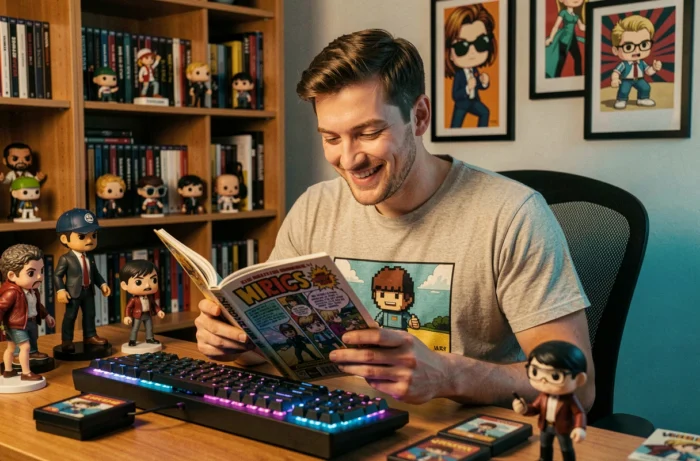
The geek culture has long ceased to be just a niche segment. It structures entire sectors of the entertainment industry, from video games to streaming and the market for licensed merchandise. Understanding its current dynamics requires looking beyond the showcases and catalogs of figurines.
French Video Game Industry: A Fragile Sector Despite an Active Market
The video game sector in France is going through a delicate phase. The 2025 industry barometer, reported by Le Figaro in October 2026, indicates that nearly one in two companies reported being in deficit. Many of them lacked financial visibility beyond a year.
This fragility does not only concern large publishers. Les Échos describes a marked contrast between the difficulties faced by major French studios, which are experiencing waves of layoffs, and the survival strategies of small independent studios. Some manage to stand out thanks to unexpected successes, but funding remains a constant point of tension.
For enthusiasts closely following these changes, L’Antre du Geek regularly covers news on releases, reviews, and trends that animate the video game scene and pop culture in a broader sense.
This economic context has direct repercussions on the diversity of titles produced in France. When financial visibility decreases, ambitious or experimental projects often fall by the wayside in favor of safer bets, which impoverishes the offering in the medium term.

Digital Accessibility and Video Games: What the European Act Changes
Since June 28, 2025, the European Accessibility Act applies to certain public digital services, including online commerce. The question for video games arises in specific terms: the game itself does not appear on the list of services targeted by the text.
However, the online store and the purchasing process may fall under e-commerce. The legal analysis published by Videas in September 2026 highlights this distinction. A game may escape the regulatory framework, but not its sales platform. This interpretation remains to be confirmed by case law, leaving legal uncertainty for publishers and distributors.
Accessibility as a Design Lever
The accessibility of video games is not just a legal constraint. It can also be viewed as a full-fledged design experience. Adapting interfaces, haptic feedback, or subtitle options enriches the experience for a much broader audience than just players with disabilities.
Studios that integrate these parameters from the design phase often find that their ergonomic choices benefit all users. This is an area that geek culture, accustomed to valuing technical innovation, would do well to emphasize further.
Pop Culture and Licenses: The Weight of Merchandise in the Geek Universe
The merchandise market remains an economic pillar of geek culture. Figurines, licensed clothing, collectibles, office accessories: these products generate significant revenue for rights holders. Specialized shops are multiplying online, each betting on a different positioning.
Several criteria distinguish a serious offer from a generic catalog:
- The presence of official licensed products, ensuring quality of manufacture and fidelity to the original material (comics, manga, video games, cinema)
- The regular rotation of references, aligned with major cultural releases (films, series, AAA games)
- A catalog that covers multiple universes without limiting itself to the most visible franchises, including science fiction, Japanese animation, and independent comics
- Accurate information about materials, dimensions, and manufacturers, allowing collectors to make informed choices
The classic trap remains impulsive buying on generalist platforms, where counterfeits circulate abundantly. Checking for the official license before purchasing any figurine or merchandise avoids many disappointments, especially in the secondary market.
Geek Magazines and Specialized Media: A Format That Endures
The magazine Geek, published quarterly, continues to bring together a community of readers attached to the long format. Covering video games, comics, science fiction, and pop culture, this type of publication offers an editorial perspective that online news feeds struggle to replicate.
France TV, for its part, offers the Côté Geek collection, gathering content around gaming, animation, and science fiction. Geek-themed streaming is structuring itself as an editorial genre, with selections aimed at audiences that consume this content transversally.
Complementarity Between Print and Digital
Print is not dead in the geek universe; it simply occupies a different function. A quarterly magazine allows for in-depth reports, thorough reviews, and long interviews that the daily pace of the web does not favor. The two formats feed off each other: the web creates urgency, while print provides depth.
The geek culture is thriving as a cultural ecosystem. Its economic tensions, particularly in the French video game sector, deserve as much attention as its commercial successes. Questions of digital accessibility, still unclear legally, will shape part of the debates in the coming years. Following these issues closely means understanding where this universe is truly headed.