
A table that is 180 cm long does not always guarantee eight comfortable places: the space taken up by the legs or the width of the seats can reduce the available space for each guest. Some standards recommend a minimum of 60 cm per person, but this figure varies depending on the type of meal and the shape of the table.
There are discrepancies between standard models and actual needs. The rectangular shape does not offer the same conviviality as a round or oval table, and the circulation around the furniture depends as much on the layout of the room as on the chosen dimensions.
Choosing the right size for your dining table: what you really need to know
Balancing comfort, efficiency, and available space in the dining room is not a simple equation. For a table for eight people, it’s not just about stacking centimeters on the measuring tape. The ideal dimensions depend on both the balance of the table top, the freedom of movement at the table, and how the whole integrates into your space.
Length, width, height: every detail plays a role in your dining experience. For a rectangular table, expect it to be between 180 and 200 cm long, and 90 to 100 cm wide, so that everyone feels at home. In terms of height, the standard is around 75 cm, suitable for most commercially available chairs, but it’s always good to check with specific models. Round or oval tables, on the other hand, encourage movement and conversation, but you need to calculate differently to avoid elbowing each other at every shared dish.
Asking what the ideal dimensions for a table for 8 people are is to reject a one-size-fits-all rule. It’s about finding the right compromise: sufficient width to place dishes and plates, a length designed not to crowd guests, and enough free space under the table for everyone to sit comfortably. It’s better to observe the room, carefully measure the circulation spaces around the table—at least 80 cm to move without obstacles—and select the shape that will best fit the geometry of the space. The goal? So that everyone can stand up, sit down, pass the dish without bothering their neighbors, and enjoy the meal in complete peace.
What size for a table for 8 people (and for 4, 6, 10, or 12 guests)?
Determining the ideal table size based on the number of guests is a mix of logic and experience. To gather eight people around a rectangular table, you should plan for a length between 180 and 200 cm, and a width of 90 to 100 cm. These dimensions ensure everyone has adequate space without encroaching on the conviviality of the meal.
But the rectangle does not monopolize the dining room. For a round table accommodating eight people, aim for a diameter of at least 150 cm. The absence of corners facilitates exchanges and movement. Square models, less common but notable, generally require a side length of 140 to 160 cm. As for the oval table, it fits easily into long rooms; its dimensions are similar to those of the rectangle, but the visual effect remains softer.
Here’s an overview of the recommended dimensions based on the shape of the table and the number of seats:
- For 4 people: 120-140 x 80 cm (rectangular), 100-110 cm (round), 90-110 cm (square)
- For 6 people: 150-180 x 90 cm (rectangular), 120-130 cm (round), 120-140 cm (square)
- For 8 people: 180-200 x 90-100 cm (rectangular), 150-160 cm (round), 140-160 cm (square)
- For 10 people: 220-240 x 100 cm (rectangular), 180 cm (round), 160-180 cm (square)
- For 12 people: 260-300 x 100 cm (rectangular), 200 cm (round), 200 cm (square)
| Number of people | Rectangular (cm) | Round (cm) | Square (cm) |
|---|---|---|---|
| 4 | 120-140 x 80 | 100-110 | 90-110 |
| 6 | 150-180 x 90 | 120-130 | 120-140 |
| 8 | 180-200 x 90-100 | 150-160 | 140-160 |
| 10 | 220-240 x 100 | 180 | 160-180 |
| 12 | 260-300 x 100 | 200 | 200 |
When space is limited or uses vary, the extendable table stands out. Closed, it remains discreet; open, it easily accommodates a large family dinner or visiting friends. This type of model is perfect for multifunctional rooms, which transition from daily meals to receptions. The ideal is to choose the length that corresponds to your routine while keeping the option to add a few extra place settings for festive days.
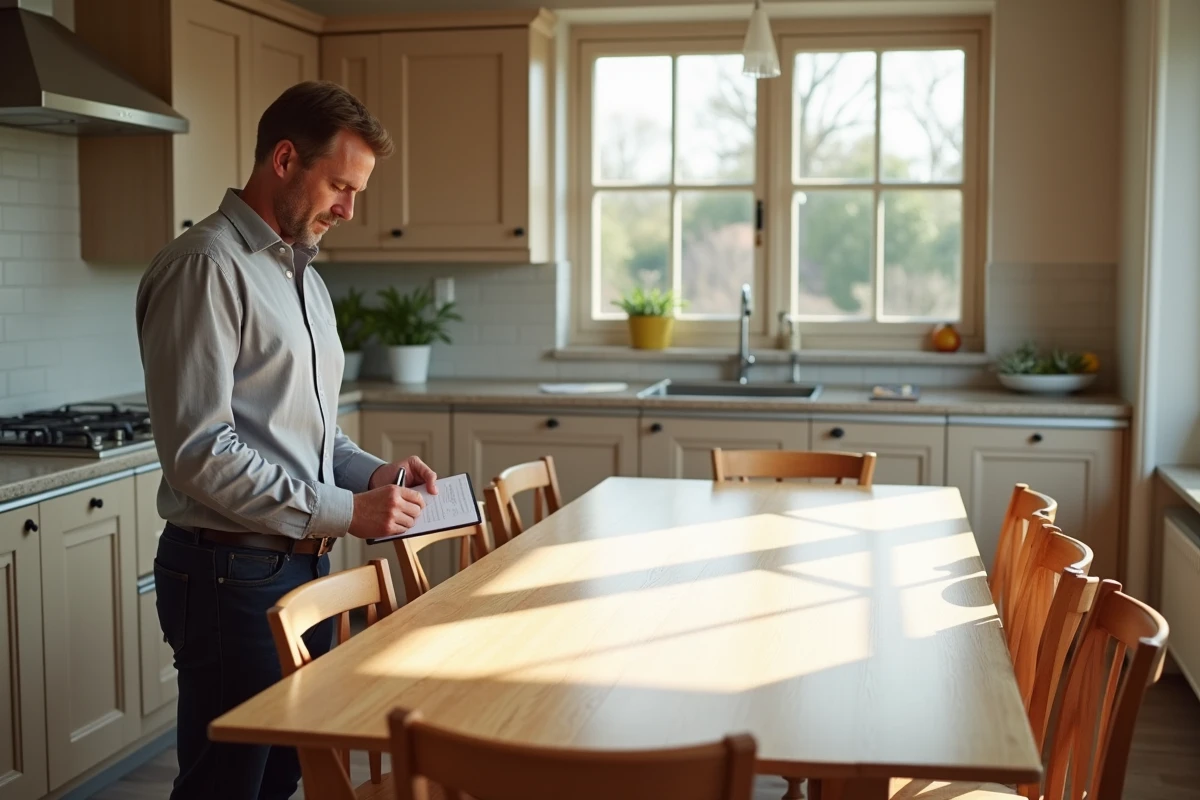
How to adapt the table to your space and ensure comfortable circulation
Setting up a dining table for eight people is not just a matter of measurements. The circulation around the furniture makes all the difference in daily life. You should allow at least 90 cm of clearance between the table and surrounding walls or furniture. This passage allows everyone to sit down or stand up without destabilizing the whole or disrupting the flow of service.
The constraints of the room often dictate the choice: a narrow room calls for a rectangle, while a square space readily opens up to a round table. The right ratio between the size of the table and the available surface ensures a pleasant and functional space. If the table is too large, it hinders storage and blocks the room. If it’s too compact, it stifles convivial moments and limits the welcoming of guests.
The choice of chairs is not trivial. You should count around 60 cm for each guest, ensuring that the backs do not hit the walls. This calculation avoids unpleasant surprises during long dinners. Extendable tables, again, allow for space modulation without overdoing it.
To better visualize the distances to respect, here are some guidelines:
- At least 90 cm between the table and walls or surrounding furniture
- 60 cm of width per person to sit comfortably
| Element | Recommended distance |
|---|---|
| Between table and wall/furniture | 90 cm |
| Per person (width) | 60 cm |
Never underestimate visual balance: a well-proportioned table that captures light and allows the room to breathe transforms the dining area into a place where people enjoy gathering. This is where it all begins, and where memories are made, around a table of the right size.