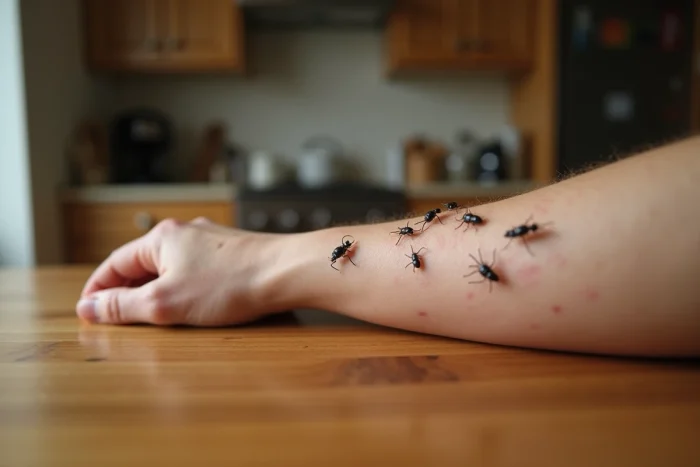
Identifying a tiny black insect found on the skin presents a concrete problem: the reaction to adopt depends entirely on the species. Some of these insects sting, others cause dermatitis simply by being crushed, and a good number end up there accidentally, with no parasitic intent. Comparing their physical characteristics and behaviors allows for a quick sorting of the actual risk.
Comparative table of small black insects found on the skin
| Insect | Size | Color | Sting or bite | Skin risk |
|---|---|---|---|---|
| Thrips | Less than 2 mm | Black to brown | Accidental contact, no real sting | Slight irritation, no typical allergic reaction |
| Adult carpet beetle | 2 to 4 mm | Black with light patterns | None | Larvae cause dermatitis through their hairs |
| Bed bug | 4 to 7 mm | Brown-red to black after feeding | Sting with blood feeding | Itching, bumps in lines or clusters |
| Tiger mosquito | About 5 mm | Black with white stripes | Sting with blood feeding | Swelling, vector risk (dengue, chikungunya) |
| Paederus (rove beetle) | 7 to 10 mm | Black with red reflections | No bite | Severe dermatitis if crushed on the skin |
| Fungus gnat | 2 to 4 mm | Black | None | None |
This table highlights a point that many identification forums overlook: the majority of these insects pose no direct danger. Among the six species listed, only two actually sting to feed on blood. The others end up on the skin by chance or due to light attraction.
A detailed guide on tiny black insects on the skin delves into the identification criteria for each of these species.

Thrips and fungus gnats: false parasites often confused with pests
Thrips are probably the most common source of confusion. These tiny insects, associated with houseplants and gardens, land on the skin purely by chance. Their presence increases in spring and summer, when populations explode on plants near homes.
The tingling sensation felt when coming into contact with a thrips does not correspond to a sting in the entomological sense. The insect does not have a mouthpart adapted to pierce human skin. The discomfort comes from the mechanical contact of its rough mouthparts, designed to shred plant cells.
Fungus gnats follow a similar pattern. Attracted by the moisture of potting soil, they fly around the face and land on the skin without ever stinging. Their black color and small size trigger a disproportionate concern compared to the actual risk, which is none.
Reducing their presence in the house
- Allow the surface of the potting soil to dry between waterings to break the reproductive cycle of fungus gnats
- Keep houseplants away from resting areas (bed, sofa) during population peaks in spring
- Set up sticky yellow chromatic traps near pots to capture adults before they disperse into rooms
Paederus: a black insect that burns the skin without stinging
The case of Paederus deserves special attention because it illustrates a counterintuitive risk. This small black beetle with red reflections does not bite or sting. The danger only occurs if it is crushed on the skin.
Its hemolymph contains pederin, a substance that causes a characteristic linear dermatitis. The lesions resemble chemical burns and appear between 12 and 48 hours after contact. Confusion with an allergic reaction or a spider bite is common.
The right reflex when encountering a Paederus on the skin: gently slide it off with a piece of paper or blow on it. Never crush an unidentified black insect directly on the skin; this simple precaution avoids the majority of dermatitis related to this species.
Bed bugs and tiger mosquitoes: the real biters to identify quickly
Among all the small black insects that may come into contact with the skin, bed bugs and tiger mosquitoes are the only ones whose presence requires swift action.
Bed bugs: distinguishing signs
The adult bed bug measures between 4 and 7 mm, takes on a darker color after a blood meal, and leaves characteristic marks on bed textiles: small black spots (droppings) and blood stains. Stings often appear grouped in lines or clusters, which distinguishes them from isolated mosquito bites.
A bed bug infestation cannot be resolved with surface treatments. Calling in a professional remains the only reliable approach to eliminate individuals hidden in mattress seams, baseboards, and bed frames.
Tiger mosquito: frequent confusion with other black insects
The tiger mosquito is recognized by its black body striped with clear white stripes. It bites during the day, unlike the common mosquito. Health authorities emphasize one point: prevention relies primarily on eliminating stagnant water around the home (saucers, gutters, abandoned toys in the garden).
- Empty or turn over any container that can hold water, even in small amounts, every week
- Install mosquito nets on bedroom windows and use a fan (the airflow hinders the flight of the tiger mosquito)
- Store outdoor items that create micro-reservoirs of water after rain

When faced with a tiny black insect on the skin, the first reflex should be observation, not crushing. The size, body shape, presence or absence of wings, and context (indoors, garden, proximity to plants) guide identification much more effectively than an anxious search on a forum. In the vast majority of cases, the insect in question has no reason to be there and will not return.